Meta Sequenced Events: A B2B Lead-Quality Lever That Depends on Your Downstream Data
Meta Ads is surfacing a Sequenced Events option in some website-based Leads campaigns. In accounts where the functionality is appearing, advertisers define an initial event and a higher-value final event, and Meta's interface says the ad is credited only when both occur in order.
For B2B advertisers, that could make it possible to optimize toward leads that go on to become opportunities, instead of treating every form submission as equally valuable. I see it as a promising lead-quality control that is worth testing in accounts where it fits. To truly benefit, advertisers must be able to send Meta a frequent, trustworthy downstream qualification event.
TL;DR
- In observed accounts, Sequenced Events lets website Leads ad sets optimize around an initial event followed by a higher-value final event.
- Availability does not appear universal. Meta has not published dedicated documentation on eligibility, volume requirements, or attribution.
- The final event you choose sets the downstream signal Meta receives. Pick that event based on what your sales team actually validates.
- Optimizing deeper in the funnel means fewer conversions, so low final-event volume could weaken the test.
- Judge results on qualified-lead cost, opportunity creation, and pipeline, not cost per form fill.
How Meta Sequenced Events Works and Where It Shows Up
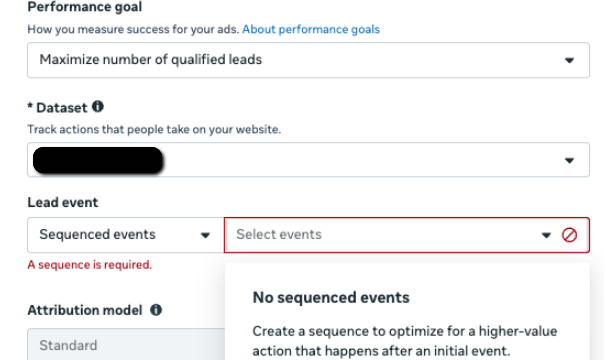
The setup lives at the ad-set level. You create a Leads campaign, choose Website as the conversion location, select Maximize number of qualified leads as the performance goal, and then choose Sequenced events as the lead event. From there, you define two steps:
- Initial event: the action people take before the conversion you care most about.
- Final event: the higher-value action you ultimately want the ad to drive.
Meta's interface describes the option this way: specify two events to optimize for a higher-value action that occurs after an initial event, and your ad is credited only if both events occur in order. In the example I use, the initial event is a lead and the final event is an opportunity.
Reported accounts have been able to select standard or custom events, though the available choices appear to vary. I could not find dedicated public Meta documentation confirming rollout scope or general availability, which suggests a limited rollout or test. Before building a test plan, check whether the option appears in your own website Leads ad sets.
What Meta Has Not Documented Yet
Several operational details remain unclear, and each one affects how confidently you can read results:
- Which accounts and event types are eligible
- Whether there is a minimum final-event volume
- How much time can pass between the initial and final events
- How attribution windows and reporting apply to the sequence
- Whether CRM integration, the Conversions API, or a particular matching method is required
Until Meta clarifies these points, I recommend treating Sequenced Events as an account-level experiment, not a settled best practice.
The Final Event Sets the Signal Meta Optimizes Toward
Sequenced Events is appealing because it adds a post-lead signal. Standard lead optimization treats a form submission from a qualified buyer the same as one from someone who will never answer a sales email. A downstream event may help delivery favor people more likely to progress. Whether it does so in your account is a hypothesis to test, not a documented outcome.
For B2B, this addresses a long-standing gap, because sales cycles have several stages worth optimizing toward. B2B advertisers have pursued similar goals on Google for years. That comparison is directional, though. Google supports several value-based and funnel-oriented optimization methods, and none of them maps exactly onto Sequenced Events.
The value depends on the final event. A qualified opportunity or a booked meeting can be a strong choice, but only if your team defines it consistently, sales validates it, and it reaches Meta accurately. A thank-you page view or a second page visit is easier to capture but says little about commercial intent. If the final event is weak, you have only moved the quantity problem one step down the funnel.
Volume Is the Constraint Most B2B Accounts Will Hit
Volume is my main caveat. Meta has not published a threshold for Sequenced Events. Still, it is reasonable to expect that a deeper event, which produces fewer conversions, gives the system less data to optimize with.
That creates a real tension for B2B. The events that best reflect quality, such as opportunities, are often the rarest. Estimate your weekly final-event volume before launching. If an account produces only a handful of opportunities a month, consider testing a nearer-funnel qualification event, such as a booked meeting, as the final step. It is a test design option, not a guaranteed fix.
Sequenced Events Is Optimization, Not a Bid Control for Opportunities
A natural question is whether Sequenced Events lets you bid more for an opportunity than for a lead. There is no documented event-level bid control or multiplier. The ad set optimizes toward people who complete both events in order.
My interpretation is that selecting Maximize number of qualified leads should push delivery toward people more likely to complete the final event. That is an inference about the performance goal, not a documented bid adjustment, so do not assume Meta applies a specific premium to opportunities.
I could see Meta eventually extending value rules to individual conversion events. That's just speculation though; and nothing available today shows that value rules can weight the two sequence events.
Judge the Test on Pipeline
A Sequenced Events ad set may produce fewer leads at a higher cost per lead. That could signal success or failure, and CPL alone will not tell you which. When you compare against standard lead optimization, focus on:
- Lead-to-qualified and lead-to-opportunity rates
- Cost per qualified lead and cost per opportunity
- Opportunity creation and pipeline value, measured over a window long enough to reflect your sales cycle
Clean measurement also depends on tracking. Meta has not said which implementation Sequenced Events requires. Audit whichever setup carries your two events, whether that means Pixel, Conversions API, and CRM event delivery or some combination. Check event quality, deduplication, and matching where they apply. If the final event arrives late, inconsistently, or disconnected from the initial event, the optimization signal and your read of the results will both suffer.
The Toggle Will Not Fix Weak Fundamentals
Sequenced Events is not a magic bullet. Creative and messaging still have to reach the intended audience and offer enough value for them to act. If the creative strategy is broken, optimizing toward opportunities will not rescue it.
For a fair test, keep creative, messaging, landing-page qualification, and sales follow-up consistent across the control and test ad sets. If you change several variables at once, you cannot isolate the optimization effect.
Where This Fits in the B2B Budget Conversation
Meta has spent years trying to win B2B budget. Its targeting generally cannot match LinkedIn's professional granularity, because LinkedIn offers more explicit professional targeting controls. Meta may compete through broader reach and campaign-level optimization instead. In my experience, many B2B buyers use Meta's platforms during work, on breaks, and after hours.
Whether Meta delivers more cost-effective qualified pipeline than LinkedIn varies by audience, market, and campaign. My view is that updates like this make Meta worth re-testing for teams that wrote it off over lead quality.
Test Sequenced Events Only When Your Downstream Signal Is Worth Optimizing
Sequenced Events targets the most common B2B complaint about Meta: plenty of leads, but too few that progress. Whether it helps depends more on your data than on the feature. Accounts with a reliable, reasonably frequent downstream event and clean event delivery are positioned to run an informative test. Accounts without that foundation risk noisy results and misleading conclusions. Fix the signal first, then run a controlled test judged on pipeline.
Before activating Sequenced Events, map the post-lead action your sales team trusts and confirm that Meta receives it accurately and often enough to support a meaningful test.
Want to know what we're seeing for early results? Drop a line to set up a call.
FAQs
What are Meta Sequenced Events?
Sequenced Events is an optimization option reported in some website-based Leads campaigns. It uses two events in a defined order. You choose an initial event and a higher-value final event, and Meta's interface states that the ad is credited only if both occur in that sequence. Meta has not published how that crediting interacts with attribution windows or reporting. In observed accounts, the option is configured at the ad-set level under the Maximize number of qualified leads performance goal.
Is Sequenced Events available in every Meta Ads account?
It does not appear to be. Practitioner reports suggest the option may show up only in eligible accounts or as part of a phased test, and Meta has not published dedicated documentation on rollout scope. Check your own website Leads ad sets before planning around it.
Will Sequenced Events improve B2B lead quality?
It may, but that remains a hypothesis to test in your own account. Results will likely depend on choosing a well-defined final event, sending it reliably to Meta, and generating enough final-event volume to support optimization. Strong creative, messaging, and qualification matter regardless of the optimization setting.
Interested in a free strategy call? Schedule time with us.

Natalie Hanson has achieves business growth for SaaS, eCommerce, and Fintech clients in the digital marketing field since 2015, with stints at Competitor Group and SmashTech before joining JDM in Dec. 2020. She has extensive experience with paid social advertising and excels in direct-response strategy underpinned by rigorous testing and data-driven performance creative. Natalie works remotely from the Sacramento area, where she partakes in all manner of outdoor activities including running, volleyball, and beach lounging.