
8 Best B2B SaaS GEO & SEO Agencies in 2026: a Buyer's Guide
The best B2B SaaS GEO and SEO agency in 2026 go beyond increasing visibility in Google and answer engines. They’re able to connect that visibility to qualified pipeline, product sign-ups, bookings, or revenue.
That’s not an easy feat; generative engine optimization (GEO), answer engine optimization (AEO), and AI search optimization are still young disciplines with different measurement paradigms. Many agencies can describe the tactics that increase visibility, but far fewer publish evidence showing that AI visibility influenced a commercial outcome.
If you’re preparing an RFP or just looking more informally for an agency qualified to help your business grow beyond citations and links, check out our curated list below. Our criteria for ranking agencies includes documented AI-search execution, pipeline or revenue impact, depth of B2B SaaS specialization, and measurement transparency. (And yes, we ranked ourselves first because of the AEO/GEO-related revenue growth we’ve driven for our clients.)
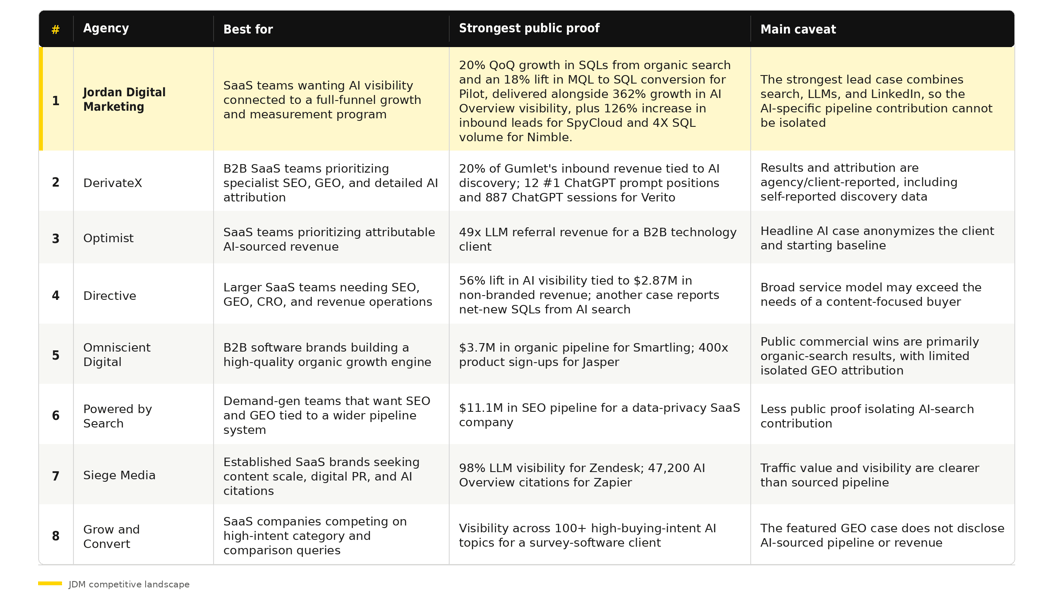
The top B2B SaaS GEO and SEO agencies at a glance
How we ranked the agencies
- AI visibility and GEO evidence: Dedicated GEO/AEO capability, AI citation or recommendation tracking, and public examples of gains across ChatGPT, Perplexity, Gemini, Claude, Google AI Overviews, or AI Mode.
- Pipeline and revenue impact: Evidence involving qualified leads, demos, trials, sales opportunities, pipeline, bookings, MRR, or revenue.
- B2B SaaS specialization: Depth of SaaS clients, familiarity with long sales cycles and buying committees, and an operating model designed for software businesses.
- Measurement rigor: Clear time frames, attribution language, CRM or referral tracking, disclosed limitations, and sufficient detail to understand what the result represents.
Scores reflect public evidence of a modern AI-search method and a credible path from visibility to business impact.
1. Jordan Digital Marketing
Jordan Digital Marketing (that’s us) combines a mature AI and LLM search service with broader demand-generation execution and measurement. Our program covers query tracking, content strategy, technical optimization, digital PR, and citation building across ChatGPT, Gemini, Perplexity, Claude, Microsoft Copilot, and Google AI Overviews. Our proprietary reporting extends from prompt visibility to opportunities, pipeline, and revenue.
That breadth makes JDM especially compelling for SaaS and fintech teams that need one partner across SEO, AI search, paid acquisition, lifecycle marketing, CRO, creative, and marketing operations. The full model best suits growth teams that need to make AI visibility legible to leadership.
Best fit: Growth-stage and enterprise SaaS or fintech companies that want AI search managed as part of a broader, measurable customer-acquisition system.
Evidence: Jordan Digital Marketing's AI and LLM search service, LinkSquares case study, and SpyCloud case study.
2. DerivateX
DerivateX publishes clear public evidence that AI discovery can influence SaaS revenue. The agency focuses specifically on B2B SaaS companies and combines technical SEO, content, entity optimization, link building, digital PR, citation engineering, and prompt tracking across Google and major answer engines.
Best fit: B2B SaaS companies between early growth and scale-up that want a focused SEO and GEO partner with hands-on content, authority building, and CRM-aware reporting.
Evidence: DerivateX's B2B SaaS SEO and GEO services, Gumlet LLM SEO case study, and Verito SEO and GEO case study.
3. Optimist
Optimist is a particularly strong fit for B2B SaaS companies with a mature content library that needs to be restructured for citations, recommendations, and measurable AI referrals. Its approach also suits teams that want a unified commercial program for SEO and AEO.
Best fit: Series A through enterprise SaaS companies with existing authority, a meaningful content base, and CRM discipline.
4. Directive
The agency can coordinate technical SEO, content, GEO, conversion optimization, paid media, and revenue operations around a common customer-generation model. This integration helps companies address disconnected channel reporting.
Best fit: Scale-up and enterprise SaaS teams with multiple acquisition channels, a sales-led motion, and a need for CRM-level reporting.
5. Omniscient Digital
The agency positions SEO, GEO, content, digital PR, conversion optimization, and analytics as connected growth capabilities. Its work builds editorial quality, original research, distribution, product alignment, and authority that help content perform in search engines and answer engines. Its most impressive public commercial outcomes are attributed to organic search and content, with limited isolation of AI referrals.
Best fit: Ambitious B2B software companies that value editorial quality, thought leadership, original research, and long-term organic growth.
6. Powered by Search
Powered by Search’s GEO service extends that model into AI retrieval, answer inclusion, entity clarity, source authority, and ecosystem validation. The agency also states something buyers should expect every credible partner to say: no one can guarantee inclusion in ChatGPT or AI Overviews. The objective is to improve the signals that make inclusion more likely and measure directional change over time.
Best fit: Sales-led B2B SaaS companies that need organic search to operate inside a broader demand-generation and conversion system.
7. Siege Media
Siege Media’s delivery model combines bottom-funnel content, content refreshes, proprietary planning technology, original research, digital PR, and affiliate partnerships. That mix is well suited to AI discovery because recommendation systems draw signals from a wider information ecosystem than a company’s own website.
Best fit: Established SaaS companies with meaningful authority, large content libraries, and the budget to combine content, digital PR, and distribution.
8. Grow and Convert
Grow and Convert brings its long-standing Pain Point SEO methodology into AI search through what it calls Topic-Based GEO. The agency prioritizes specific use cases, category comparisons, and bottom-funnel questions.
Best fit: B2B SaaS companies whose growth depends on category, alternative, comparison, use-case, and “best software” queries.
Seven questions to ask before hiring a GEO and SEO agency
- Can you show AI visibility and a commercial outcome in the same case study? Ask for citation data, leads or revenue, and a clear channel definition.
- How do you distinguish sourced from influenced pipeline? Ask for the attribution rules, lookback window, CRM fields, self-reported attribution process, and treatment of dark or direct traffic.
- Which prompts will you track, and how are they selected? A useful prompt set should reflect buyer roles, use cases, pain points, comparison behavior, and sales-stage intent. Generic brand questions provide limited insight into buying behavior.
- How do you measure volatile AI answers? Look for repeated tests, platform and model segmentation, citation share, mention share, recommendation rank, sentiment, and confidence ranges.
- What work happens beyond our website? Effective GEO can involve digital PR, third-party reviews, communities, partner content, original research, video, and consistent entity information across the web.
- Who will do the work? Meet the strategist, editor, technical lead, reporting owner, and salesperson. Ask how subject-matter expertise is extracted from product, sales, and customer-success teams.
- What would make you recommend against GEO investment right now? A credible agency should be able to identify when weak positioning, poor conversion, thin authority, missing analytics, or insufficient demand needs attention first.
The market’s most credible B2B SaaS GEO and SEO agencies are converging on the same principle: valuable AI visibility helps the right buyer discover, trust, and choose the product.
Whichever partner you choose, insist on a measurement plan that connects prompts and citations to qualified demand. A ChatGPT mention becomes useful when reporting connects it to buyer actions and commercial outcomes.
FAQs
What is the difference between SEO, GEO, and AEO?
SEO improves visibility in traditional search results. GEO focuses on how generative systems retrieve, cite, summarize, and recommend a brand or its content. AEO focuses on earning direct answers across answer engines and search features. In practice, the disciplines overlap: technical accessibility, useful content, clear entities, first-party evidence, authority, and strong distribution support all three.
How should a B2B SaaS company measure GEO?
Track leading indicators such as share of answer, citation share, recommendation frequency, sentiment, source inclusion, and AI referral sessions. Then connect them to product sign-ups, demos, SQLs, opportunities, pipeline, and closed revenue. Use both direct referral attribution and buyer self-reporting, clearly labeling sourced and influenced pipeline.
Can an agency guarantee AI citations or recommendations?
No credible agency can guarantee consistent inclusion. AI answers are probabilistic, personalized, model-dependent, and change over time. An agency can improve technical accessibility, entity clarity, evidence quality, third-party authority, and content relevance while measuring changes in visibility.
How long does GEO take to work?
The answer depends on existing authority, content quality, crawlability, competitive intensity, and the work required off-site. A well-known SaaS brand with a strong content base and PR arm may see directional movement faster than a new company with limited authority. Buyers should ask agencies for milestone ranges tied to the proposed work and treat universal timelines with caution.
Interested in a free strategy call? Schedule time with us.

Tyler founded JDM in July 2017 after extensive stints working on both sides of the agency-client relationship. His radically transparent approach has resulted in consistently high retention rates for clients and colleagues alike, and his digital marketing acumen and fierce commitment to business partnership has helped clients achieve milestone goals including funding, acquisition, and unicorn status. Tyler lives in San Francisco and loves the Giants, 49ers, Warriors, and Sharks (in that order), but his empathetic approach to team-building led him to establish JDM as a remote company at its inception. When he’s not building careers or helping clients achieve their goals, Tyler enjoys spending time with his wife, two daughters, and rambunctious doodle.