

SaaS AI & LLM Search: Trends, Pain Points & How to Fix Them
Buyers are increasingly asking ChatGPT, Perplexity, and other AI experiences to explain options, compare vendors, and summarize what matters. The search journey has changed, and your measurement and optimization strategy needs to incorporate more than Google clicks and impressions.
In December, I sat down with Head of Growth Adam Tanguay to walk through the core ideas behind the Guide to Growing AI Search Visibility, plus what a practical “start now” approach looks like.
Here are some of the highlights and takeaways.
AEO is built on SEO foundations
Crawlability and site fundamentals don’t change just because it’s AEO. You still need to nail the basics:
- Models must be able to find and access your content
- Your pages should be linked together so they can be discovered
- Your headings are clear
- Your markup is set up correctly
If that foundation is weak, it’s hard to show up consistently.
Set up measurement first, aim for perfection later
Measurement is the first place to start because AI visibility is harder to tease out than traditional search traffic. What you’re trying to understand:
- Where you’re showing up (and where competitors show up)
- What prompts or topics are driving visibility
- Where you’re getting cited
- What people do after they see you
Get to know query fan-out: when one question turns into many searches
In practice, one user prompt can trigger multiple sub-queries behind the scenes and then get stitched into a single answer. In other words, one question can effectively behave like many searches.
What that means for AEO strategy:
- You can’t optimize for one keyword and call it done
- You need to anticipate the different angles the model might explore
- You should aim to answer the broader set of questions surrounding the main topic
Why FAQs and comparisons matter so much in AI answers
When people prompt “best X” or “compare these options,” the model needs clean, structured information it can evaluate quickly.
Two formats that help you get ahead of that:
- FAQs that answer specific questions clearly
- Comparison content that helps the model distinguish options and features
This is one of the fastest ways to align your content with how AI answers get assembled.
Citations: are the AEO version of link building
There’s a major difference between SEO and AEO.
- In SEO, link building often means earning lots of high-quality links from many places.
- In AEO, you may see fewer sources repeated, and certain sources showing up often.
Example: Reddit and Wikipedia appear frequently in some answer sets.
The practical takeaway: make “where am I getting cited?” a regular part of your visibility check.
Build a content strategy that compounds: hub-and-spoke, but faster
Adam described modern SEO strategy as “owning a concept” and covering it from different angles that matter to your audience. His point was that LLMs accelerate this dynamic because users can explore those angles instantly through prompts.
Another key detail: models are good at chunking content, and AEO tends to reward chunk-level relevance (especially if the chunk answers the query and its fan-out), not just keyword density across a full page.
Want to hear more in real time?
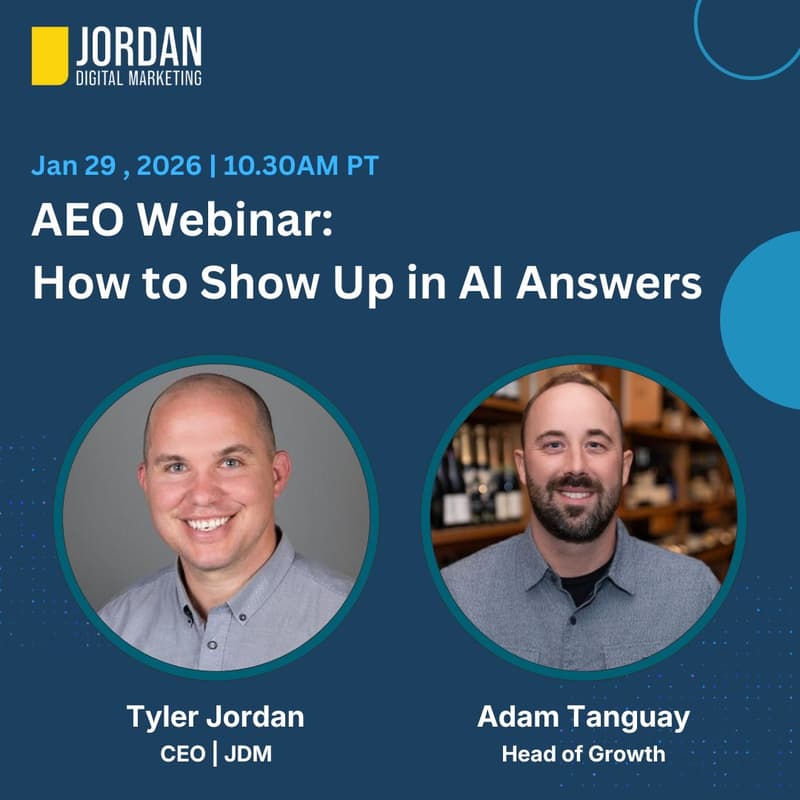
Adam and I are hosting a free webinar on Thursday, Jan. 29, to share the tactics that have built AI search visibility for our clients. Register now to block your calendar and bring questions for the live Q&A.

Tyler founded JDM in July 2017 after extensive stints working on both sides of the agency-client relationship. His radically transparent approach has resulted in consistently high retention rates for clients and colleagues alike, and his digital marketing acumen and fierce commitment to business partnership has helped clients achieve milestone goals including funding, acquisition, and unicorn status. Tyler lives in San Francisco and loves the Giants, 49ers, Warriors, and Sharks (in that order), but his empathetic approach to team-building led him to establish JDM as a remote company at its inception. When he’s not building careers or helping clients achieve their goals, Tyler enjoys spending time with his wife, two daughters, and rambunctious doodle.