Google Tests Exact and Phrase Match in AI Mode: JDM's Take
Ads in AI Overviews are now very much a thing – but advertisers need to know how to show up before wrapping their minds around the growth potential.
Shopping, Performance Max, and AI Max for Search are the campaign types Google says are best positioned to appear inside AI Overviews, as that format eats more of the results page. Placement, however, is not handed to you because you picked the right campaign type. Whether your ads surface depends on feed quality, landing page content, audience signals, and creative diversity.
The decision Google made was where to concentrate its automation. The decision you still control is what you hand that automation to work with, and right now, most advertisers are underfeeding it.
TLDR;
- Google is steering Shopping, PMax, and AI Max ads toward AI Overviews placements, but campaign type alone does not guarantee you will show up.
- Feeds, landing pages, audience signals, and creative are the inputs that actually decide eligibility, and those are the variables still under your control.
- With less traditional SERP real estate to fall back on, a competitor appearing in AI Overviews while you are absent is a bigger visibility gap than it used to be.
- Attribution and reporting for AIO placements are still catching up, so calibrate expectations on performance visibility.
- The role shifts from managing campaigns to managing signals: strong creative, tight landing pages, clean first-party data.
Google Has Decided Where the Action Is
By signaling that Shopping, PMax, and AI Max are the campaign types positioned for AI Overviews, Google is telling advertisers exactly where its own product investment is going. When the platform concentrates its automation in one surface, that surface is where the impressions accumulate.
My read on this is a visibility urgency issue more than a feature adoption one. A few years ago, missing a placement meant a competitor edged you out in one spot while you still had room to compete elsewhere on the page. That cushion is thinner now. As AI Overviews take up more real estate, the "elsewhere" that used to absorb a missed placement is shrinking. A competitor showing up in AIO while you are absent represents a larger gap than the same absence would have created before, and the cost of doing nothing has gone up to match.
So the question is not whether to chase a shiny new placement. The question is whether the campaigns you already run are solid enough to be eligible for the surface Google is prioritizing.
What Google Can't Do Without You
Automation decides where and when your ads appear. It doesn’t decide what you give it to work with. That input layer is where advertisers still have real leverage, and it breaks into four parts.
Feeds and landing pages do more work than you think
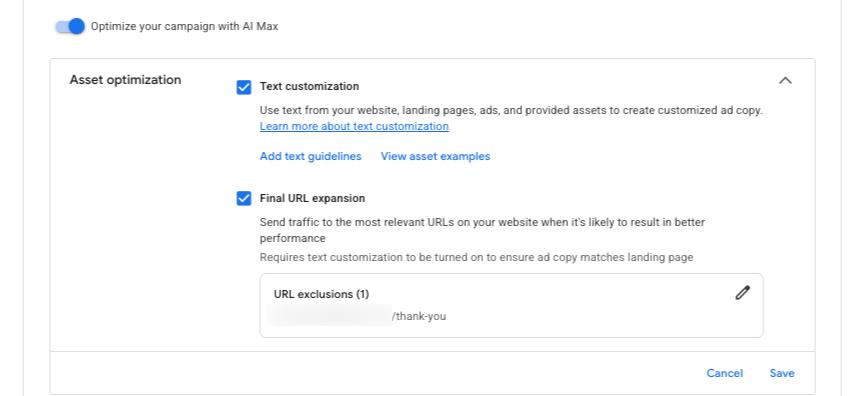
Final URL expansion pulls from your landing page content, and AI Overviews serve contextually against conversational queries. Generic sales language becomes a liability in that environment. Treat landing page language alignment as its own optimization task, separate from offer alignment. Aligning the offer isn’t the same as aligning the language a page uses to answer the who, what, how, and why behind an intent-based query. Rich, information-first content gives Final URL expansion something useful to draw from. Thin promotional pages give it scraps.
Creative has to span funnel stages, not just the close
Bottom-funnel conversion creative covers one slice of query intent. AI Overviews respond to a wider range, so your assets need to cover more of the journey, not only the moment someone is ready to buy. Diversify formats and ratios (square, landscape, vertical) and write headlines that inform rather than push. Pair that with a realistic creative refresh and rotation cadence. Active asset rotation signals engagement to the algorithm and gives it more to test, and that signal is not nothing.
First-party data is your steering wheel
Now that Google controls placement decisions, audience signals and first-party data are the primary levers for guiding automation toward the right people. Strong signals and strategic exclusions are how you keep an automated system from spending against the wrong intent. Feed it clean data and it makes better relevance calls. Feed it nothing, and it guesses.
One caveat worth stating plainly: this is not a purely paid play. Organic authority and relevance signals factor into AIO eligibility too. If your paid team and your SEO team are operating in separate rooms, that’s a structural problem for this surface specifically.
Where the Playbook Breaks Down
Excitement should come with a measurement asterisk. Attribution and reporting for AIO placements are still catching up, which means performance visibility is murkier than what advertisers are used to from standard paid search. You can do everything right on the input side and still find the reporting layer behind the curve in telling you precisely what those placements drove.
Calibrate expectations accordingly. Treat early AIO performance the way you would treat any surface where measurement lags the inventory: feed it strong signals, watch for directional movement, and resist the urge to declare a verdict before the reporting tools mature. The opportunity is real, even if attribution to prove it line by line is not fully there yet.
From Campaign Management to Signal Management
The core shift is moving from control to inputs. For years, paid search rewarded operators who controlled the levers directly: bids, match types, placements, the works. Google decides where and when ads serve now, so the operator's job changes shape. The main priority becomes feeding the machine the best possible signals: strong, creative, solid audience data, tight landing pages.
When does this demand action versus a quick check? For advertisers already running Shopping, PMax, or AI Max who are not actively managing feed quality, landing pages, or audience signals, this is pressing. That is where the gap between eligible and invisible opens up. For advertisers on those campaign types who already run disciplined input management, this is closer to verifying alignment than overhauling anything. For advertisers not running those campaign types, AIO ad eligibility is not yet relevant to you, though the broader move toward automation-driven placements should still shape how you structure any paid search account going forward.
The Gap Between Showing Up and Being Prepared
Eligibility for AI Overviews is the byproduct of feeds, landing pages, creative, and audience signals that give automation enough to work with. Google made its bet on where the action lives. The advertisers who benefit will be the ones whose inputs were already strong when that surface expanded, not the ones who scrambled to react after a competitor showed up and they did not.
If your Shopping, PMax, or AI Max campaigns aren't built around strong feeds, landing page alignment, and first-party data, you may already be losing ground to competitors showing up in AI Overviews. Book a strategy call with us to start reclaiming that ground.
FAQs
Which Google Ads campaign types can appear in AI Overviews?
Google has signaled that Shopping, Performance Max, and AI Max for Search are the campaign types best positioned to appear inside AI Overviews. Running one of those campaign types does not guarantee placement, though. Eligibility depends on feed quality, landing page content, audience signals, and creative diversity.
Why isn't choosing the right campaign type enough to show up in AI Overviews ads?
Campaign type only makes you a candidate. AI Overviews serve contextually against conversational queries, and Final URL expansion pulls from your landing page content, so the inputs you provide decide whether automation surfaces your ads. Weak feeds, thin landing pages, generic copy, or poor audience signals can keep you out even on the right campaign type.
Can I measure AI Overviews ad performance the way I measure standard paid search?
Not yet with the same precision. Attribution and reporting for AI Overviews placements are still catching up, so performance visibility is murkier than traditional paid search. Treat early results as directional, keep feeding the system strong signals, and avoid drawing firm conclusions before the reporting tools mature.

Lifelong learner Ronni loves the dynamic nature of digital marketing; every day brings a new release or feature to test to find growth in client accounts, including YouTube ads, TikTok ads, Google ads, LinkedIn ads, and Meta ads. From developing brand designs and logos to teaching her teammates the latest and greatest from developing ad platforms including TikTok, Ronni is passionate about raising the bar for marketing performance that drives business growth, particularly for her JDM clients.