
Client Background
Pilot is a leading provider of bookkeeping, tax, and CFO services for startups and small businesses. Their platform combines expert financial services with modern software to help companies manage finances, stay compliant, and scale efficiently.
Challenge
Pilot had strong domain authority and a robust content library, but was underperforming in emerging AI-driven search experiences.
Key challenges included:
- Limited visibility in AI Overviews (AIOs) for high-value queries
- Under-optimized content for definition-based and mid-funnel search intent
- Competitors winning first 1–3 SERP positions and AIO citations by providing more structured, extractable answers
- Missed opportunity to capture LLM citations and AI-driven discovery from pilot.com (from chatbots like ChatGPT, Claude, Meta AI, Microsoft Copilot, Perplexity and more)
The goals were to:
- Build scalable topical authority in accounting, tax, and SMB finance topics
- Increase AIO visibility and keyword ownership
- Improve top 1–3 SERP ranking and AIO citations across priority terms
Strategy
We reframed SEO as Answer Engine Optimization (AEO) — optimizing for both traditional search rankings and selection by AI systems (Google AIO + LLMs).
The LLMs that we tracked included the following chatbots: ChatGPT, Claude (Anthropic), Google AI Mode, Google Gemini, Grok, Meta AI, Microsoft Copilot, and Perplexity.
Our initiatives stemming from this strategy, which were supported by research and measurement from Profound, were as follows:
1. Expand Glossary Pages to Create an Authority Engine
We transformed glossary pages into high-performing AEO assets by structuring them for both users and machines:
- Introduced clear, 1-paragraph canonical definitions for extractability
- Expanded pages with context, examples, and formulas
- Added internal links to deeper guides and commercial pages
- Incorporated high-authority external references (.gov, trusted sources)
This turned glossary pages into:
- Definition hubs (easily extracted for AIO)
- Entity anchors (for LLM understanding)
- Internal linking nodes (for authority distribution)
2. Conduct AIO Gap Analysis + Achieve Content Parity
We analyzed competitors ranking in the top 1–3 positions and being cited in AIOs:
AI systems and Google AI Overviews generate conversational responses using large language models that rely on natural language processing (NLP) to understand, retrieve, and synthesize information. By analyzing Google NLP patterns and content structures, we recognized an opportunity to address definitional, intent-based queries to improve Pilot.com’s visibility in AI Overviews for glossary content. In executing this alignment, we enhanced user experience through more informative definitional content, while optimizing Pilot’s content structure to align with the way LLMs and AI Overviews parse and interpret information.
- To increase AIO citations, we optimized content structures to clearly define and answer “what is [bookkeeping or tax term]” queries, making glossary pages easier for AI Overviews to identify and cite.
- To increase LLM citations, we aligned content with RAG-based retrieval by emphasizing concise, entity-driven answers, increasing citation likelihood across both LLMs and Google AI Overviews, which use similar retrieval and synthesis mechanisms.
- To improve SEO visibility, we analyzed why competitor pages were being selected via content gap analyses and incorporated those features into Pilot’s content approach.
In all initiatives, we focused intently on:
- Answer clarity
- Formatting for extraction via NLP sentence structures
- Entity completeness
- Quality and quantity of information
Building and optimizing pages that aligned with and enhanced these patterns drove improvements across AI Overviews, LLM citations (e.g., ChatGPT, Claude, Gemini, Perplexity), and traditional SEO rankings.
3. Apply Intent Layering (Mid-Funnel Bridge Strategy)
We targeted keywords that formed a bridge from informational to commercial intent.
Examples included:
- “Tax write-offs for small businesses”
- “Common small business tax deductions”
This allowed Pilot to capture early research traffic and funnel users into high-intent, high-conversion service pages.
4. Execute Internal Linking for Topical Depth
We implemented a structured internal linking system:
- Glossary → service and product pages
- Glossary ↔ glossary (semantic clustering)
- Guides & Blogs → glossary reinforcement
This strengthened:
- Topical authority signals
- Crawl efficiency and context understanding
- Conversion pathways
Results
Our bespoke Pilot AEO strategy delivered significant gains across rankings, visibility, and AI-driven discovery:
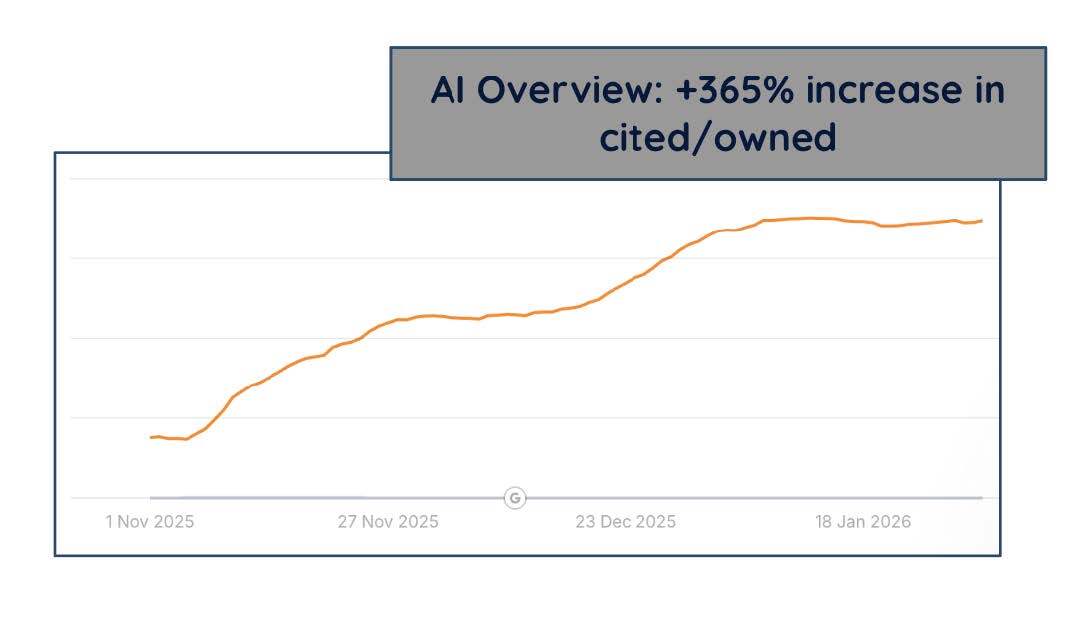
- +362% increase in AIO visibility
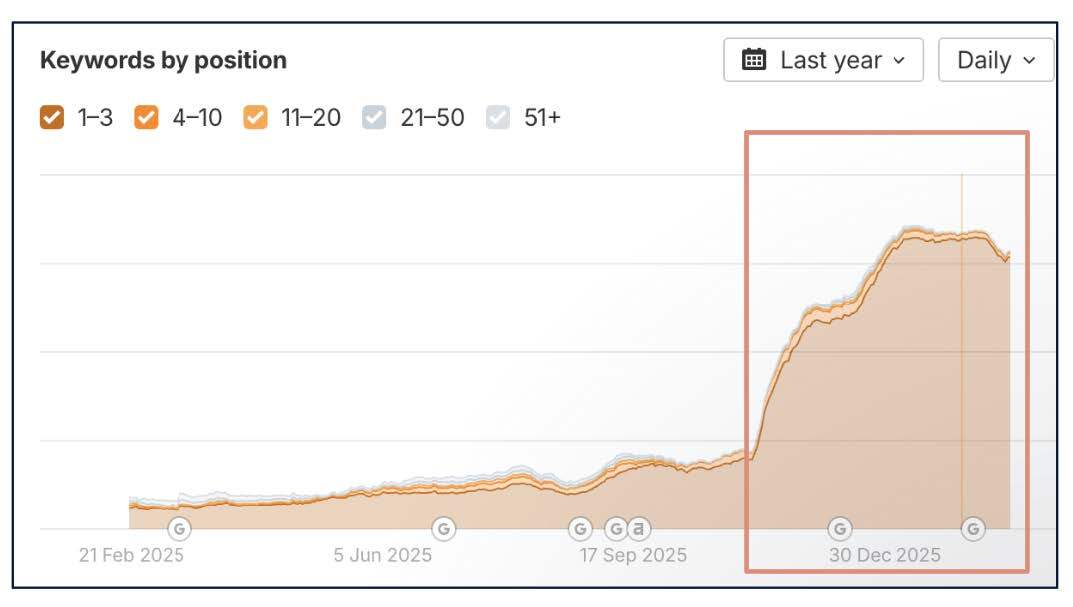
- 4.1x increase in Top 1–3 keyword rankings
- +30% growth in total ranking keywords
Traffic Impact by Intent
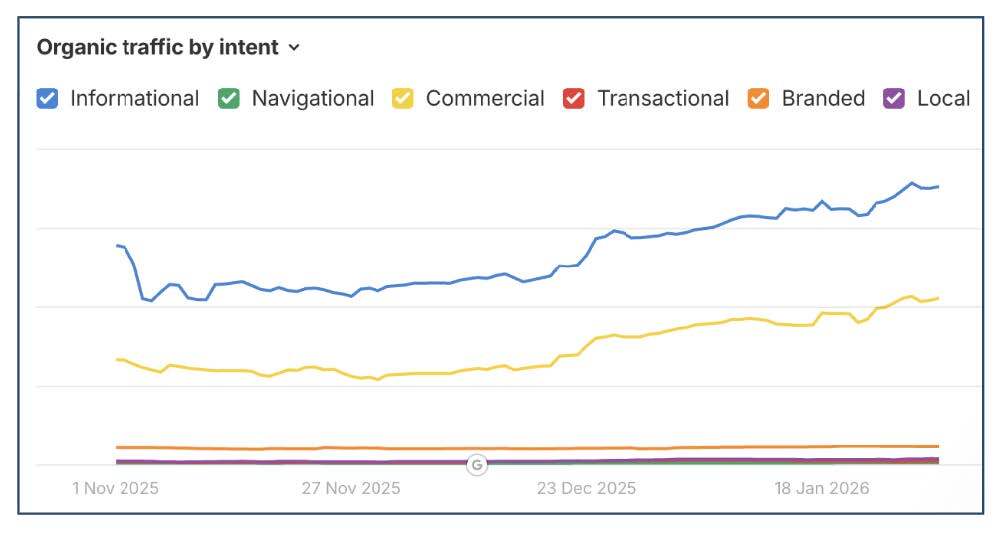
- Informational traffic: +25%
- Commercial traffic: +61.5%
- The increase in commercial intent keyword coverage (+61.5%) contributed to higher-intent organic traffic, supporting the 20% QoQ growth in SQLs from organic and improvements in MQL→SQL (+18%) conversion rates, indicating a measurable impact on pipeline quality and revenue efficiency.
Organic Leads → Increased demand capture
SEO investments, including expansion into commercial intent keywords, drove an increase in organic traffic entering the funnel, reflecting improved visibility and stronger click-through from search.
Result: Increased top-of-funnel demand from organic search.
Organic MQLs → Improved lead quality
Despite implementing stricter MQL qualification criteria, conversion rates improved (+18% MQL → SQL), indicating that a greater share of incoming traffic met higher quality thresholds.
Result: Higher-intent, more relevant leads driven by improved keyword targeting.
Organic SQLs → Measurable pipeline impact
Organic-driven SQLs grew +20% QoQ, demonstrating that SEO efforts translated into an increase in sales-ready leads and tangible pipeline contribution.
Result: Direct impact on pipeline generation from organic search.
Query Ownership Growth
- +25% increase in informational query ownership
- +61.5% increase in commercial query coverage
Glossary Program Wins
- 19 glossary pages moved from positions 11–50 into Top 10
- Significant increase in AIO inclusion across glossary terms
LLM Visibility (Downstream Impact)
LLM visibility measures how often a brand is surfaced and cited in AI-generated responses. This takes into account visibility across the following chatbots: ChatGPT (OpenAI), Google Gemini, Google AI Overviews / Google AI Mode, Claude (Anthropic), Perplexity, Microsoft Copilot, Grok, and Meta AI.
Following the LLM visibility gains, Pilot:
- Held the #1 spot for a combined array of core topics like "Outsourced Accounting Services," “Bookkeeping Services,” and “Tax Preparation Services.”
- Improved LLM citation rankings by a total of +40 positions QoQ across all tracked topics.
- Recorded a +50% increase in glossary page citations across LLMs.